Decoding the FET form your must know guide to foreign money transfers in Thailand
🇹🇭 Decoding the FET Form: Your MUST-KNOW Guide to Foreign Money Transfers in Thailand
If you are buying property or receiving substantial funds from overseas in Thailand, there is one document you absolutely need to understand: the FET Form.
While the term might sound complex, the concept is simple and its importance cannot be overstated. Get this wrong, and you could face significant delays or even be unable to complete a property purchase!
Here is everything you need to know about the Foreign Exchange Transaction Form (FET).
🔍 What Exactly is an FET?
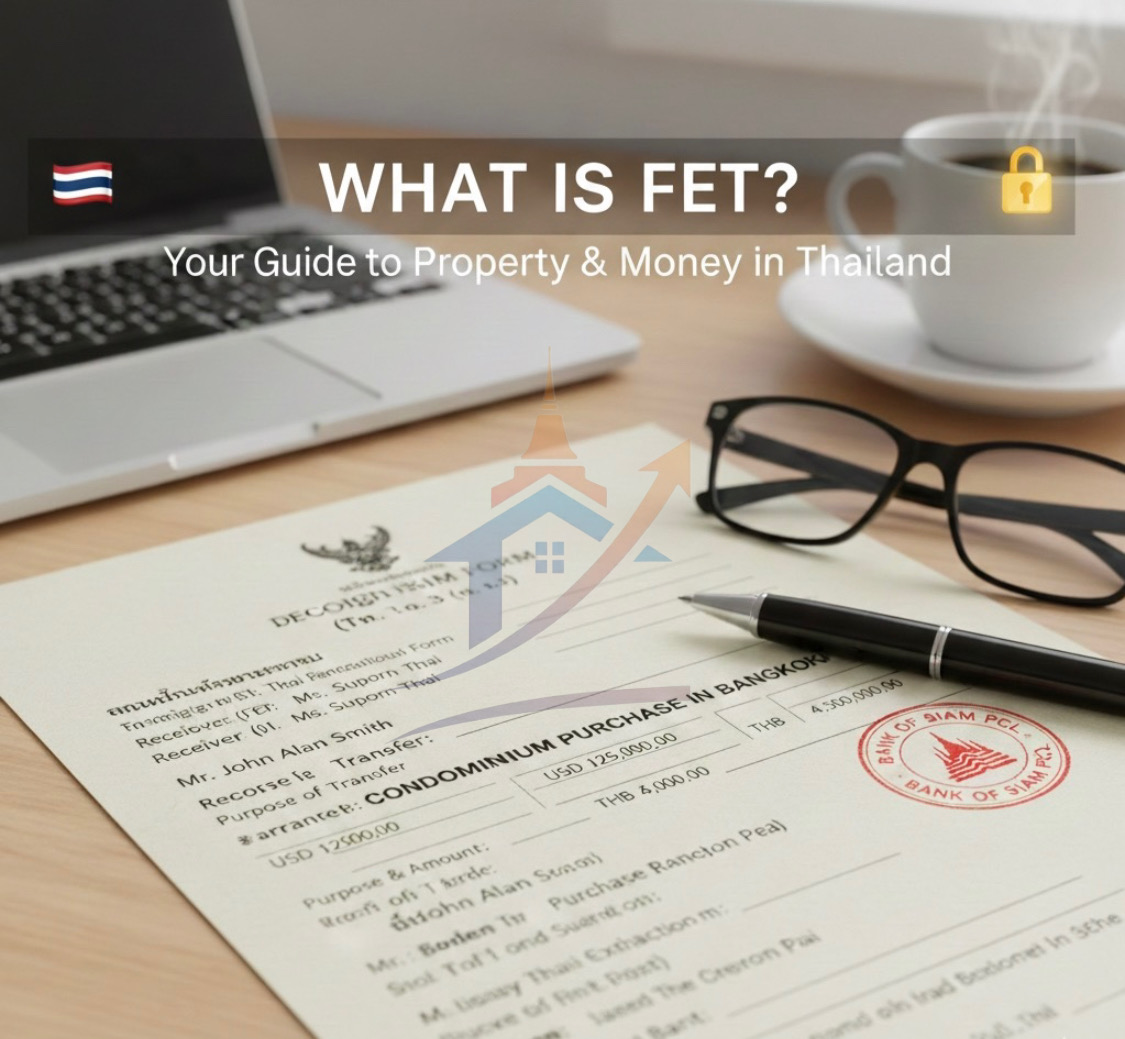
FET stands for Foreign Exchange Transaction Form.
It is an official document issued by a commercial bank in Thailand when money is transferred from overseas in a foreign currency (USD, EUR, SGD, etc.) and converted into Thai Baht.
Its core function: The FET serves as official, undeniable proof that the funds used in Thailand originated from abroad.
🧾 When is the FET Form Essential?
The FET form is a crucial document in several key scenarios, particularly for foreigners.
🏢 1. Buying a Condominium in Thailand (The Most Critical Use)
This is the number one reason a foreigner needs an FET.
- The Law: Foreigners buying a condo in their own name must prove that the funds used for the purchase were brought into Thailand from overseas.
- The Consequence: You MUST present the FET at the Land Office to complete the transfer of ownership. No FET means you cannot transfer the title.
💸 2. Large Transfers Over $50,000 USD (or Equivalent)
Thai banks are legally required to prepare an FET form for any incoming transfer that is the equivalent of USD 50,000 or more. - Note: The bank automatically prepares this, but it is your responsibility to request and collect the physical copy.
🔁 3. Sending Money Back Overseas (Repatriation)
If you decide to sell your property or investment and wish to transfer the money back out of Thailand (repatriation of funds), the original FET form is your key. - Proof: You MUST show the original FET as proof that the money initially came from abroad.
- Warning: Losing this document can make it extremely difficult, costly, or even impossible to send the same amount of funds back out of the country later.
📈 4. Investment Purposes
For certain formal investment activities, such as buying shares or investing in a company, the FET may be required to document the foreign source of the capital.
❌ When Might You Not Need an FET?
For smaller transfers, typically under the USD 50,000 threshold, Thai banks usually issue a Foreign Currency Exchange Slip (sometimes called a “Credit Note” or similar).
While this slip is generally accepted for most everyday purposes, be aware that it is often NOT sufficient to satisfy the strict requirements for a condo purchase at the Land Office. If you are buying a property, aim for the FET.
⚠️ A Crucial Warning on Currency
Do NOT send Thai Baht (THB) from overseas if you plan to buy a condo.
For the transaction to qualify for an FET (and for the Land Office to accept it), the funds must arrive in Thailand in a foreign currency (USD, EUR, AUD, etc.) and then be converted into THB by the receiving Thai bank.
🧩 What Information is on the FET Form?
The FET acts as a detailed transaction receipt and includes key information: - Sender & Receiver: Full names of the person/entity sending and receiving the funds.
- Amount & Currency: The exact amount and currency transferred.
- Purpose of Transfer: The stated reason for the transfer (e.g., “Condominium Purchase,” “Investment”).
- Exchange Rate: The rate used for conversion to Thai Baht.
- Issuing Bank: The name of the Thai bank that performed the transaction.
💡 4 Essential Tips Before You Transfer Money
- ✔ Transfer in Foreign Currency: Always send USD, EUR, etc., not THB, if you plan to use it for property.
- ✔ State a Clear Purpose: Instruct the sending bank to include a specific, clear purpose on the transfer (e.g., “For Condominium Purchase at [Condo Name]”). This will be recorded on the FET.
- ✔ Request and Keep All Documents: Immediately upon transfer, contact your receiving Thai bank branch to collect the physical FET form. Treat it as a priceless legal document.
- ✔ Plan Ahead: Ensure you have the FET prepared before your scheduled appointment at the Land Office.
✨ Final Takeaway
If you are a foreign buyer planning to secure ownership of a condominium in Thailand, the FET is your single most important document.
No FET = No Ownership Transfer.
Make sure you understand the requirements and work closely with your bank to ensure this document is prepared correctly every time you transfer funds for a major purchase.